
Bambra Agroforestry Farm on ABCTV Landline
Landline on ABCTV featured a story about our agroforestry work. It includes the harvesting and milling of one of our trees and shows how we are using the timber in our new house frame. The story also has an overview of the Stewart Family farm (Yan Yan Gurt West) and their commercial native flower project.
You can watch the full feature HERE.

Bambra Tree Sleeve:
Wallaby, Kangaroos and Sheep tree guard
The flexible tree guard designed by Rowan Reid to allow grazing by sheep and protection from wallabies
See Bambra Tree Sleeve information page for details and watch the YouTube video on the guard HERE
Purchase posts and sleeve in our SHOP


-----------------------
Bambra Agroforestry Farm on Gardening Australia
Click on the WATCH button in the picture to watch the segment on the ABC website

-----------------------------
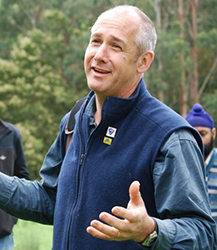
Welcome to Rowan Reid's web page
Rowan Reid (B.For.Sci. & M.For.Sci.) is a forester amongst farmers. His passion for trees began as a child in the coastal eucalypt forests of southern Victoria and has led to a life teaching and working with farmers around the world:
Web Site Contents
Bambra Agroforestry Farm: tours and courses
Rowan's new book: Heartwood - the art and science of growing trees for conservation and profit
Shop: buy tools, books, tree guards and other stuff. We only sell what we use ourselves.
Publications: lots of free book chapters, articles and papers written by Rowan Reid
Practical information: on growing and managing trees on farms
Tree Species: some examples of the species we grow for high quality timber
Ask Rowan: send an email question. Free service.
Consultant services: Rowan is available for farm consultancies, presentations, workshops etc.
Heartwood: The art and science of growing trees for conservation and profit
By Rowan Reid

The book that is changing the way people think about the future of forestry.
Produced in partnership with Melbourne Books, Heartwood is my most ambitious publishing project to date: A 300-page, hard-cover book featuring 300 colour photographs and more than 75,000 words. More detail .
Get a signed copy from the author: CLICK HERE
Bambra Agroforestry Farm

Where's Bambra Agroforestry Farm?

Follow Rowan's Bambra Agroforestry Farm


Rowan's short videos: Opinion, science and practice based on real experience

What is Agroforestry?

For me, agroforestry is the integration of trees and shrubs into farming landscapes for conservation and profit. It's all about farmers using trees to improve the environmental, social and economic values of their land. I've been working with Australian farmers for more than 30 years. From the wheatbelt of Western Australia to the Atherton Tablelands in North Queensland I don't think I've ever seen a farm that would not benefit from more tree cover or better forest management.


