Australian Agroforestry
Magazine for Australian farmers and tree growers

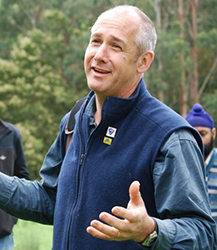
Edited by Rowan Reid

For more than 16 years Australian Agroforestry (formerly Agroforestry News) has provided practical and up-to-date information on all aspects of agroforestry and farm forestry to many thousands of tree growers and their supporters across Australia. The magazine is owned by a not-for-profit community group incorporated through the Victorian Farmers Federation Farm Trees and Landcare Association.

Next Edition Issue 68

 /edit/images_hr/THE%20BIRD%20ISSUE%20COVER.JPG

Farm birds – the proof we are making a difference

Ecologists tell us that an increase in the number of individual birds and the diversity of species on our farms indicates that we are moving towards a more environmentally sustainable agricultural landscape. The implication is that if there are more birds there are more species of insects, amphibians and reptiles, more nectar producing plants, more diverse habitat types, and more vegetation connectivity linking a landscape mosaic of both remnant and planted forests. It could also mean better pest management leading to reduced management costs, healthier crops and stock and even increased profits, but these agricultural benefits are more difficult to prove.

Past Editions

Issue 67 Spring 2010

/edit/images/AUST%20AGRO%20COVER%2067_TN.JPG

Farm grown wood is different – that’s the point

Over the past 10 years or so there has been much research and debate about the ‘quality’ of young, fast grown eucalypt timber. There is no question that, with intensive pruning and thinning, it is possible to grow large diameter logs. It is also clear that they can be milled and dried without excessive degrade. However, many buyers remain cautious about the impact of fast growth on market value.

There is no question that fast grown farm timber is different. For one, the growth rings are often more than a centimetre apart. Because native forests are fully stocked, the growth rings in conventional logs are commonly only a few millimetres apart. I’ve always thought of wide rings as a negative of our fast grown timber, particularly if used as floor boards. Stiletto heels can easily punch holes in the low density earlywood between the wide rings. But does this mean farm grown timber is always inferior?

Young furniture maker Alistair Mckendrick thinks not. He has been looking for an alternative source of timber that his environmentally conscious clients will recognise as sustainable. He argues that the fact that farm-grown timber looks different is actually an advantage. In the high value furniture market wood density and dark colours are not a selling point. In fact, being light, in both colour and weight, is the trend for those living in city apartments.

James Will of Fethers Veneers believes most architects and clients don’t know much about timber but they are influenced by labels. One of their biggest sellers at the moment is bleached and stained timber veneers that don’t look natural at all. Fethers are currently relying on environmental certification schemes such as the Forest Stewardship Council (FSC) to convey the environmental message but James feels that Australian farm-grown timber has its own story that would satisfy most of his domestic clients.

Nonetheless, some of our leading growers are finding it hard to convince buyers of the quality of their timber. Geoff North has started harvesting his carefully pruned Blue Gum only to find that his potential buyers have already lost interest in the species after being fed low quality un-pruned logs from pulpwood plantations. The research has been done but Geoff’s experience suggests that the scientists have failed in communicating the results to the potential buyers.

Whether we’re producing bush foods, timber, seed or environmental services we need to share our experiences and our enthusiasm with other tree growers. We also need to build relationships now with those who we hope might buy our products in the future. Initially, this may mean we need to share some of the risks with those who are prepared to try our product.  The customer is always right. If they’re wrong then it’s up to us to change their view.

Issue 66 Summer 2010

/edit/images_hr/COVER_AA_66.JPG

In this edition we have stories and ideas that could save your life.

Not many farmers are at the point of harvesting their trees and few have seriously considered how they might cut down a tree or pull out a sawlog. It’s so far into the future, why bother? Yet, if we get the species right, and we are successful in seedling establishment, we will end up with big trees one day. Harvesting trees for profit is a legitimate environmental management tool that can pay for the cost of planting trees for conservation whilst also enhancing the environmental values of the forest.

However, the history of timber harvesting on farms in Australia is not a good one. The use of inappropriate equipment by unskilled operators has caused damage to soils, waterways and retained trees, and resulted in unacceptable rates of death and injury. Harvesting contractors working in industrial plantations have overcome these problems by using huge expensive machines that have high re-locating costs and require large harvest volumes to be viable. Few farmers will be able to attract these contractors onto their farms, to do small jobs and may find they need to clearfell everything just to make it worthwhile.

If farm-scale, low-impact timber production is to taken seriously we need machines that are suited to small scale logging, better training of forest owners, access to specialised farm forestry contractors, a greater level of environmental care and a better safety record.

Scandinavia and Europe are clearly leading the way in the development of small scale harvesting systems and equipment. There is now a wide range of implements, log trailers and safety equipment that can be fitted to tractors. Some farmers are buying this equipment and becoming contractors themselves. Like cutting and bailing hay – the tractor equipment is getting bigger and more expensive all the time but it does allow a farmer to harvest how and when they want to and provides a means of generating paid work through off–farm contracting.

The concern I have is safety. We know that tractors and chainsaws are dangerous, and that logging already has the highest work-place death and injury rate in Australia. Should we be putting these things together and encouraging farmers to log their own forest? I see a lot of farmers using chainsaws but few have had any professional training and almost none wear a full set of safety gear. The promise of small scale forest harvesting is alluring – the risks are real. If we don’t take safety seriously there will be deaths amongst our community of tree growers.  

32 pages, 17 stories, 32 colour pictures/figures and only 9 adverts - how do we do it? It's by tree growers for tree growers.


Issue 65 Summer 2010

/edit/images_hr/COVER_OF_AA_65.JPG

Trees on farms are an important part of a low carbon sustainable future for rural Australia but they must do more than provide a once-only offset to support out continued reliance on fossil fuels. This edition looks at trees on farms as part of a 3-pronged climate change strategy:

1. Amelioration of the impact of climate variability and extreme weather events on agricultural productivity and the resource base on which it depends;
2. Diversification of farming enterprises by producing products and services that are independent of traditional agricultural markets, produce fewer emissions and are less susceptible to climate change; and,
3. Sequestration of CO2 in living biomass, soils and woody products.

32 pages, 15 stories, 32 colour pictures/figures and only 6 small adverts.

How to get the magazine

Most readers obtain their magazine via membership of a regional agroforestry, landcare or farm forestry group. Not-for-profit groups are able to order and buy copies for just $2.75 (plus bulk postage) for distribution to their members. Contact details for your group will be added to the list of groups in the magazine. We even provide the magazine in a ready-to-post A4 envelope so that the group can add their own material to prior to posting.

Individual Subscriptions are available at $20/year (includes postage) for three editions. We will post the magazine directly to these subscribers.

Bulk sales are available to individuals and bisinesses who want to re-sell the magazine for profit (as ideal addition for the counter or a nursery for example). If you but 10 copies or more are able to provide the magazine for $4/copy (including postage) and you are able to sell it for up to $7 (cover price).

For subscriptions and orders contact Marianne Stewart: marianne.stewart@australianagroforestry.org.au or on 0407 332889

We want your tree stories for the magazine

We welcome your stories, letters, photos, research reports or information about future events. We can help you put a story together. We just need something that might be of interest to tree growers. Photos should be high quality JPEG files and provided as separate files.

Contact Rowan Reid (Editor): rowan.reid@agroforestry.net.au or on 0409609939

How to Advertise in Australian Agroforestry

We don't carry pages of adverts so yours will stand out. Wide ranges of sizes and discounts for multiple adverts. DOWNLOAD OUR RATES CARD

For advertising contact Marianne Stewart: marianne.stewart@australianagroforestry.org.au or on 0407 332889